Social media isn't going away.
Instagram still has billions of users. TikTok still drives culture. LinkedIn is still where B2B happens. X is still where news breaks.
But "social media" — the way marketers have used it for the last 15 years to reach audiences, build brands, and drive revenue — is dying. Not extinct. Dying. Specifically and measurably.
The platforms are still alive. The audience-as-asset model on those platforms is in collapse.
I've been calling this for 18 months on stages, in keynotes, on podcasts. The pattern got obvious enough during the 2024-2025 cycle that I started giving the talk in book-tour rotation. This post is the data version of that talk, and one piece of the bigger argument I call Post Less, Send More.
If you're a marketer or operator still betting your business on social-first distribution, this post is for you. The five deaths are happening. The migration is already underway.
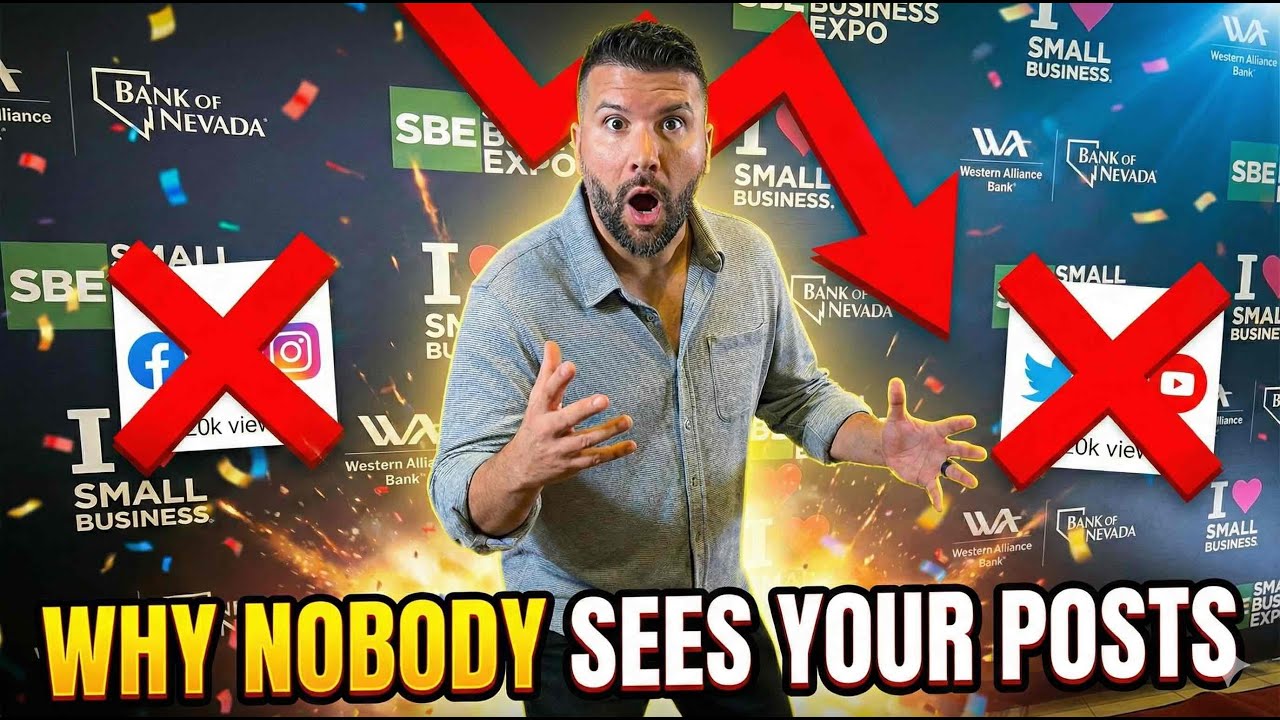
Watch the Full Breakdown
The Five Deaths Happening Right Now
What's dying isn't social media as a product. It's social media as a marketing channel that compounds value for the operator. Five separate but reinforcing collapses are underway:
Death #1: Organic Reach
The first and most measurable death. Platforms have been throttling unpaid reach for over a decade, and the rate of decline accelerated in 2024-2025 as AI content flooded feeds.
Current organic reach baselines:
- Facebook: 1-3% of page followers see a typical post
- Instagram: 2-4% organic reach on the main feed
- LinkedIn: 5-15% on personal accounts, 1-3% on company pages
- X/Twitter: 2-8% depending on engagement velocity
- TikTok: Highly variable — can be 50%+ on one viral hit and <1% on the next
- YouTube: 5-10% of subscribers see uploads in their feed
Run the math. A 100,000-follower account at 3% reach equals 3,000 humans who see your post. Of those, maybe 30 engage. Maybe 3 click. Maybe 0 convert.
That's not a marketing channel. That's an expensive content production exercise.
Death #2: AI Content Saturation
The second death is faster and more violent. AI content has flooded every social platform in 2025-2026. Most marketing posts published today have AI somewhere in the creation chain. Most of it underperforms human-led work because audiences are calibrating fast.
The pattern: AI floods feeds → audiences scroll faster → engagement drops → platforms surface more content to compensate → audiences scroll faster still → engagement collapses further.
This is a death spiral specific to social. Email doesn't have this problem because email is invitation-based. Social does because it's interruption-based and the cost of interrupting is approaching zero with AI.
Trust in social media content is at multi-year lows. Audiences increasingly assume content is AI-generated, paid, manipulated, or fake until proven otherwise. That presumption-of-falseness is poison for marketers trying to build genuine relationships.
Death #3: Audience Fragmentation
Five years ago, social media had four or five platforms that mattered. Today the relevant platforms include all of those plus TikTok, Threads, Bluesky, Substack Notes, X (functionally different now), Mastodon, Reddit, Discord communities, Snapchat for younger audiences, and various niche platforms.
Audiences are fragmenting across platforms faster than marketers can follow. Reaching the same person across multiple platforms requires multiplying production effort without multiplying outcomes. The economics break.
Death #4: Bot and Engagement Quality Collapse
The fourth death is invisible to most marketers but lethal once you see it.
Estimated bot traffic across major platforms in 2026:
- X/Twitter: 15-30% of accounts are bots or low-quality automation
- Instagram: 5-10% bot accounts in most niches; higher in influencer categories
- LinkedIn: Comparatively cleaner but rising AI-generated accounts
- Facebook: Persistent bot issues across most segments
A 100,000-follower account in many niches has 10-30% non-human followers. The "engagement" on posts includes bot likes, AI comments, and low-quality automation. The metrics operators report to themselves and their stakeholders are increasingly artificial.
This isn't a metaphor. The follower numbers literally don't represent the humans you think they represent.
Death #5: Platform Economic Pressure
The fifth death is structural. Most social platforms are publicly traded or VC-backed and need to grow revenue. The only meaningful revenue lever they have is ads. So the platforms are systematically:
- Squeezing organic reach to push operators toward paid
- Inflating ad costs as competition for limited inventory increases
- Prioritizing content that keeps users on-platform (not content that drives traffic elsewhere — like to your website or email list)
- Reducing the value of external links in feed algorithms
- Building creator monetization programs that keep money inside the platform rather than out to operators
Each platform is optimizing for its own balance sheet. The marketer's interests and the platform's interests are increasingly opposed.
The Vegas Problem
In the keynote I call this the Vegas Strategy. Social platforms run like casinos. They hand you just enough wins to keep you at the table: a post that pops, a spike in likes, a week where the algorithm loves you. Then it doesn't.
The odds are set by the house, and the house controls distribution. You can play smart and still lose, because you never owned the table.
Email flips that. When someone subscribes, you have a direct line to their inbox. No algorithm deciding who sees it. No pay-to-play. No middleman.
What "Dying" Actually Means
Social media isn't going extinct. Instagram, TikTok, LinkedIn, and YouTube will be here in 2030. People will still scroll. Brands will still post.
But "social-first marketing" — building your business around social media as the primary acquisition and audience-building channel — is dying. Specifically:
- Organic-only social as a growth strategy is dead for most operators
- Building your "audience" on a single social platform is now high-risk infrastructure
- Treating followers as your customer relationship is a category error
- Expecting social engagement to translate to revenue without owned-audience infrastructure underneath is wishful thinking
The healthy way to think about social media in 2026 is as a discovery channel and content distribution layer — not as the audience itself, not as the relationship, not as the asset.
What Smart Marketers Are Doing Instead
They're treating social as awareness, not audience.
Social media is the storefront window. It's how the right people discover you. It's not the cash register. It's not the customer file. Smart operators use social to do what social does well — generate first-touch awareness — and immediately move qualified attention off-platform.
Every social post has an underlying purpose: surface to the algorithm, demonstrate value, give the right viewer a reason to take the next step off-platform. The success metric isn't likes or comments. It's email signups, podcast listens, newsletter subscribes, course inquiries.
They're building email as primary infrastructure.
Email is the channel that survives every platform shift. Smart operators have been building email lists relentlessly since 2022 — through lead magnets, gated content, paid subscriptions, and welcome trainings. The result: a directly-reachable audience that doesn't depend on Meta's, Google's, or ByteDance's quarterly decisions.
Email isn't trendy. It's just durable. That's the entire point.
They're investing in search and SEO.
Search compounds. Social decays. Smart operators are reallocating effort accordingly — investing in long-form content, SEO-optimized blog posts, podcasts, and YouTube content that lives indefinitely.
They're building real community in owned spaces.
Discord, Circle, Skool, Slack, Mighty Networks, paid forums, private Substack communities — anywhere a relationship can be cultivated without an algorithm in the middle. Engagement in these spaces is dramatically higher than equivalent engagement on social platforms.
They're picking 1-2 social platforms instead of all of them.
The marketers winning aren't trying to be everywhere on social. They're picking one or two platforms where their audience genuinely lives and concentrating effort there — while feeding everything else into owned infrastructure.
LinkedIn for B2B founders. TikTok or Instagram for consumer brands. YouTube for educators. X for tech. Pick one or two. Get great at them. Move the audience off-platform as fast as possible.
The Migration Path
If you're currently social-first, here's the practical migration sequence:
Step 1: Build the email infrastructure. Welcome sequence, basic segmentation, weekly cadence.
Step 2: Add the conversion bridge from social. Every social bio drives to a landing page. Every meaningful post drives to a lead magnet or signup.
Step 3: Reduce social posting volume by half. Double the quality. Most operators are over-producing low-quality social content because the platforms reward volume. Smart operators are doing the opposite.
Step 4: Invest in long-form owned content. Long-form blog posts, YouTube uploads, podcast episodes. These compound over time the way social posts don't.
Step 5: Build a second owned channel. Once email is solid, add a second owned layer — community, podcast, premium content, paid newsletter.
The Counterarguments (And Why They Don't Hold)
"But my audience is on TikTok / Instagram."
Your audience is on whatever channel you can reach them. The 20,000 followers you have on TikTok are essentially worthless until they become 2,000 email subscribers or 200 customers. Use the platform where your audience hangs out for discovery. Move them off-platform for the relationship.
"Social is free. Email costs money."
Social isn't free. It costs you content production, attention, opportunity cost, and increasingly your ability to control your own marketing future. Email costs $30-300/month depending on list size. The ROI gap is so large the question isn't "can I afford email" but "can I afford to keep relying on social."
"Younger audiences live on TikTok / Snapchat."
Younger audiences still check email — they use it for school, work, accounts, subscriptions, real communication. The frequency may be lower but the trust per-message is higher. And younger audiences who interact with your brand commercially expect email-based interaction.
"AI will fix social media."
AI will make social media worse, not better, for the next 3-5 years. More content production. More indistinguishable AI accounts. More noise. More algorithmic interference. The platforms benefit from the noise because it increases the value of paid promotion. Operators don't benefit.
What's Coming Next (2027 and Beyond)
1. Paid social will dominate organic social entirely by 2027-2028. The "organic growth on social" playbook will be functionally dead.
2. Email will continue its quiet renaissance. Every ESP is growing. Newsletter operators are scaling faster than social-only creators.
3. New "social" platforms will emerge — and most of them will fail. The smart move isn't chasing them — it's owning the infrastructure that survives whichever platforms win.
What to Do This Week
Three specific moves in the next 7 days:
1. Audit your social bio and pinned content. Every social profile should drive to a landing page that captures email. If your bio says "DM me" or links to a homepage with no email capture, fix that this week.
2. Build or improve your welcome email sequence. The first 5 emails a new subscriber receives are the highest-conversion moment in your entire marketing system. Most operators have 0-2 emails and they're poorly written.
3. Pick one social platform to scale back from. Whichever platform you're spending the most time on with the least clear ROI — cut your posting volume in half. Reallocate the time to email and long-form owned content.
Results may vary. Past performance does not guarantee future results.
Why This Matters for Your Business
I've spent the last decade helping operators build the email and owned-audience infrastructure that survives every social platform shift. Through GetResponse, where I served as Contracted Brand Evangelist. Through SendFocus, where my team builds these systems for clients. Through my own brands (Outlaw Masks, The Hype Section) where I lived the lesson firsthand.
Every engagement starts with the same conversation: the operator has been social-first. The math doesn't work anymore. They need to migrate to owned.
If you want this applied to your business, book a Strategy Day. Four hours synchronous, a 25-page written strategy report, 30 days of Slack support. $2,500 flat.
Not ready for that? Start with the Revenue Engine, my free 32-page framework for turning a list into income. Get the free Revenue Engine →
Related Reading
- I'd Rather Have 1,000 Email Subscribers Than 100,000 Followers → — The positive case for email; this post is the negative case against social
- Email Marketing vs Social Media in 2026 →
- Why Creators Are Leaving Social Media for Email in 2026 →
- How to Use AI for Marketing in 2026 →
- Outlaw Masks Case Study →
- Watch all keynotes →